Oct 30, 2026Electric Stacker
Electric Pallet Truck vs Stacker: What's the Difference? (2027 Guide)
Electric pallet jack vs stacker: compare lift height, capacity and turning radius, then choose. We build pallet trucks, stackers and reach trucks - ask us.
Quick answer: An electric pallet truck — most buyers search it as an electric pallet jack — raises the forks only 10–20 cm, so it moves loads horizontally and can carry up to 5 t. A stacker lifts 1–3 t to as much as 5 m, so it can put a pallet on a rack beam. If the load never leaves the floor, buy the pallet truck. If it has to go up, buy the stacker.
Both machines are small electric forklifts built for warehouse work: battery-powered, emission-free handling equipment in the same family as the counterbalance truck and the reach truck. They look alike, they work the same aisles, and buyers routinely collect quotes for both. This guide sets out exactly where an electric pallet jack and a stacker overlap, where they diverge, and how to choose between them.
What is an electric pallet truck and what is a stacker?
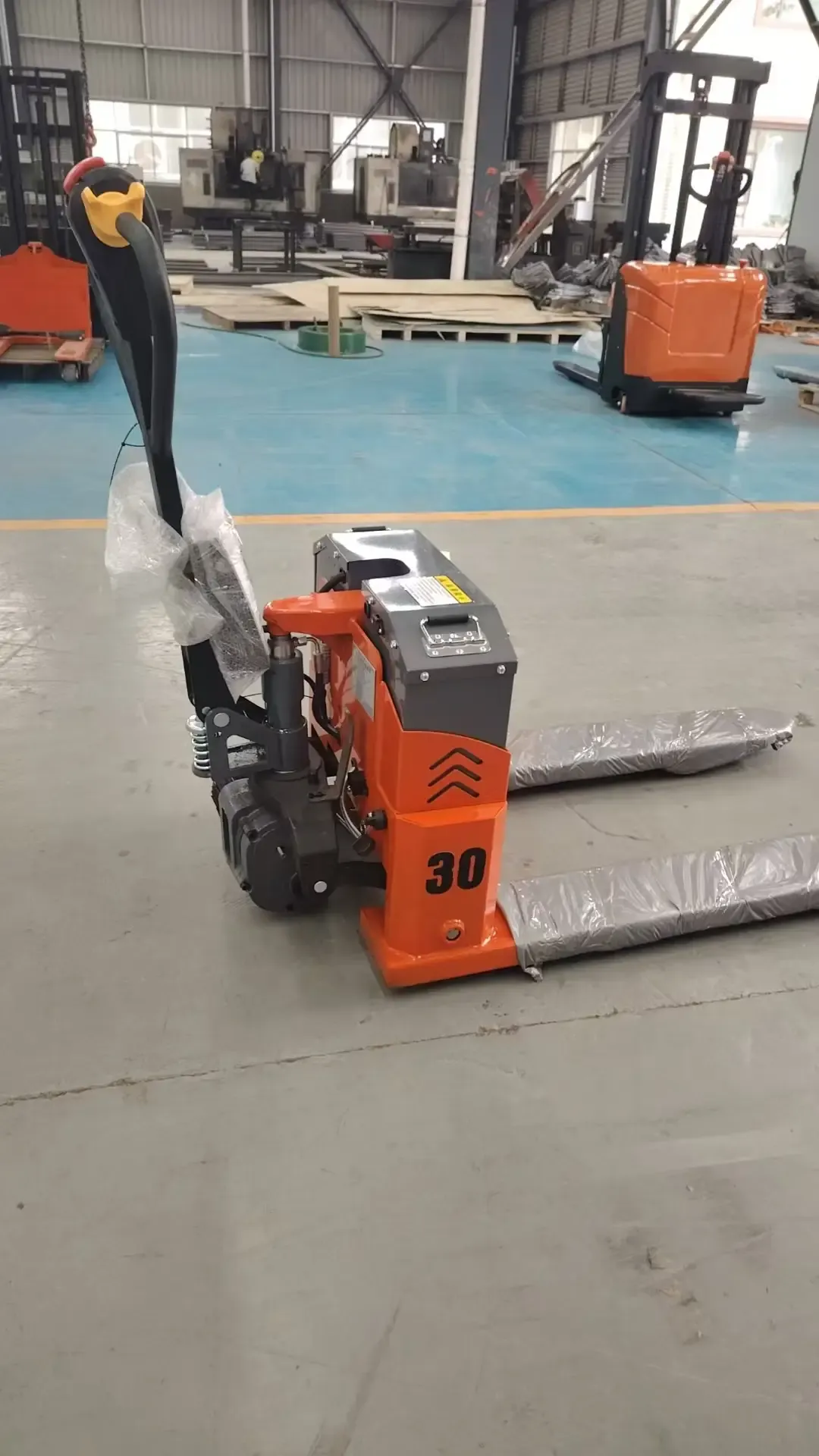
An electric pallet truck — also sold as a powered pallet truck, and searched far more often as electric pallet jack — is a low-lift machine. The forks slide under a pallet, hydraulic power raises them just enough to clear the floor, and the truck carries the load to the next position. Lift height is 10–20 cm. Capacity runs from 2 t to 5 t, and the common North American size, the 3300 lbs electric pallet jack, sits at the lighter end of that range.
This is a 3T electric pallet truck bellow.
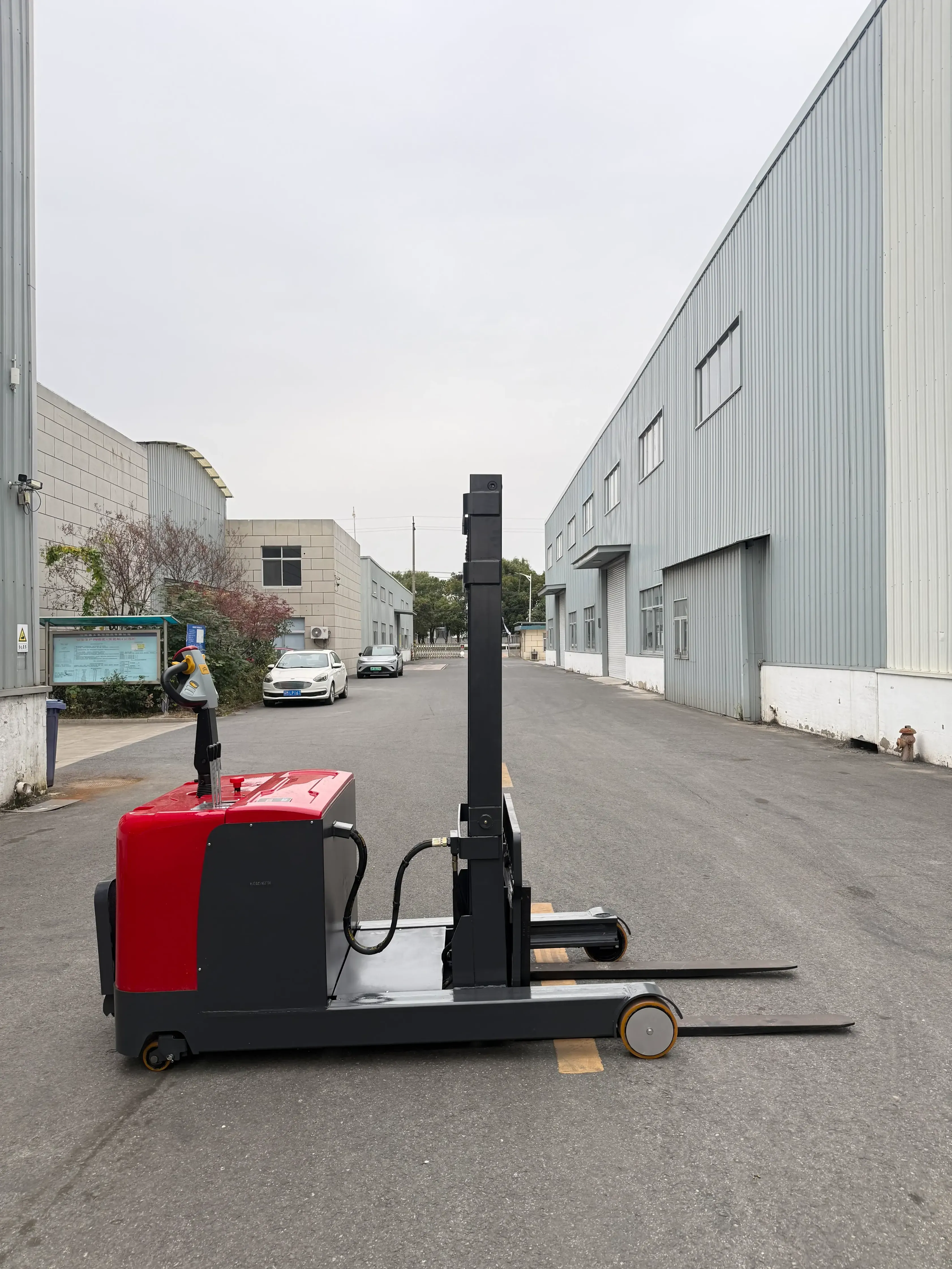
A stacker — sold as pallet stacker, stacker truck or electric pallet stacker — adds a mast. It still moves pallets, but it can also lift them to rack level: 1–3 t of load up to roughly 5 m once the legs are widened. The electric stacker family runs from the manual hydraulic stacker through the semi electric stacker to the fully powered and stand-on versions, and a walkie stacker is simply the pedestrian-controlled variant. Our complete pallet stacker guide breaks all eight variants down by load, lift height and operating style.
This is a stand-on stacker reach forklifts.
For the wider picture of how these machines sit alongside counterbalance and VNA trucks, see our guide to the different types of electric forklifts and their applications.
Where an electric pallet jack and a stacker are the same
The two categories share more than buyers expect. Five things are effectively identical.
Motor and battery
Both use the same drive architecture: a traction motor for travel and a lift motor for the hydraulics, fed by either a lead-acid pack or a lithium electric pallet jack battery. Chargers, connectors and voltage options are common to both lines, which keeps spares and service simple. An electric pallet jack battery change is a swap rather than a rebuild, and both chemistries fit the same compartment — so the choice is made at order, not after the first failure.
Tight turning radius
Both turn inside 1.5 m, which is why they work in aisles a counterbalance forklift cannot enter. An electric pallet truck turns in about 1.3 m; a stacker is very close to the same figure. A narrow electric pallet truck built for congested floors can be tighter still. If aisle width is your constraint, our guide to choosing a forklift that matches your warehouse aisles explains how to measure turning radius and right-angle stacking width.
Indoor applications
Neither machine produces emissions, so both suit indoor work — food, pharmaceuticals, electronics, general warehousing. No exhaust extraction and no ventilation upgrade are needed.
Customisation options
Fork spread is the same on both: 550 mm or 650 mm outer width to match Euro and US pallet standards. Battery chemistry can be specified either way. A ride on pallet truck and a stand-on stacker both exist for operators who cover long distances and want to cut walking time. Off-road tyres — larger wheels for uneven ground or yard surfaces — can be fitted to either machine.
Similar value for money
Both are among the cheapest powered handling equipment you can import. Buying an electric pallet truck or a stacker from a Chinese electric pallet truck manufacturer carries much the same cost advantage, because both sit inside the electric forklift family and share the same supply chain. If importing is new to you, read our guide on how to import a forklift from China — it covers documents, duties and shipping steps, and it is all you need.
Where they differ
Two differences decide most purchases: how much the machine can carry, and how high it can reach.
Load capacity
An electric pallet truck carries 2–5 t. A stacker carries about 1–3 t. That is worth pausing on. A pallet truck small enough to slip under a pallet can still handle 5 t, while a stacker with a full mast is held to a lower figure. The limit is deliberate: the higher a load is lifted, the more stability governs the design, so stacker capacity is capped for safety rather than for lack of power.
Lift height
The pallet truck lifts 10–20 cm, which is all it needs — enough to get the pallet off the floor and roll it away. The stacker lifts up to about 5 m with widened legs, and that is what lets it place a pallet on the second or third rack beam instead of merely delivering it to the aisle.
Specification | Electric pallet truck (pallet jack) | Stacker |
Load capacity | 2–5 t | 1–3 t |
Lift height | 10–20 cm | Up to ~5 m (widened legs) |
Main job | Horizontal transport, loading and unloading | Lifting to rack level, stacking |
Turning radius | ~1.3 m | ~1.3–1.5 m |
Motor and battery | Traction motor + lift motor, lead-acid or lithium | Same |
Fork spread | 550 / 650 mm | 550 / 650 mm |
Relative price | Lower | Higher as lift height rises |
Best fit | Floor-level movement, trailers, order picking | Racking, stacking, high racks |
Price follows directly from that table. An electric pallet jack price stays low because there is no mast, no tall hydraulic cylinder and no tall stability structure to build; a stacker that reaches 5 m costs noticeably more for the same load. For indicative figures across the whole electric range, see our electric forklift price and rental cost guide.
Which one should you buy?
Work through four questions in order.
- Does the load ever go above floor level? If it goes onto a rack, you need a stacker. If it only travels from the trailer to the staging area, a pallet truck is enough.
- How heavy is the pallet? Above 3 t, the pallet truck is the only option of the two.
- How far does the load travel? Long runs favour a ride on pallet truck or a stand-on stacker; short shuttle moves suit a walkie pallet jack.
- What is the rack height and aisle width? Match lift height to the top beam you actually use, and confirm the machine fits the aisle. If you are not yet sure which family you are even shopping in, our guide to forklift classifications maps every category — pallet truck, stacker, counterbalance, reach truck and VNA — against the job it is built for.
If you are still deciding between these machines and a counterbalance forklift or a reach truck, the selection logic is set out in our guide to choosing the right forklift or stacker for your warehouse. That comparison covers footprint, lift height and throughput — the three numbers that decide the family before price ever enters the conversation.
FAQ
Do I need to check fork dimensions when buying a stacker or a pallet truck?
Yes. Fork dimensions are the one specification buyers most often get wrong, and the cost of getting it wrong is a machine that cannot enter your pallets. Outer fork width is normally 550 mm or 650 mm, and you should measure your own pallets rather than assume. Euro and US pallet standards differ, so confirm the exact figure with the manufacturer before the order is placed and then keep that standard for every machine you add to the fleet.
What else should I confirm with the manufacturer before ordering?
Local voltage and plug type. Machines are built for 110 V, 220 V or 240 V supplies, and the plug varies by market. Confirming both at the quotation stage means the truck works the day it arrives instead of waiting for an electrician.
Which battery should I choose for an electric pallet jack?
If you are buying online from a Chinese supplier, choose lead-acid. It is stable, proven, and classified as ordinary cargo, so it ships without special handling. Lithium gives more usable capacity and better runtime per charge, which matters for multi-shift work, but lithium packs are classed as dangerous goods and cannot travel on the same route. For a side-by-side comparison of cycle life, charging behaviour and total cost, see our guide to lithium-ion versus lead-acid forklift batteries.
Not sure which machine fits your floor?
Tell us the load, the rack height and the aisle width, and we will tell you which one you actually need — a pallet truck, a stacker, or something else entirely. We manufacture pallet trucks, stackers, electric forklifts and reach trucks, and we have spent more than ten years building and exporting them. Any question, however small, is welcome: ask us and you will get a straight answer, not a sales pitch.