3-Wheel vs 4-Wheel Electric Forklift: Which One Fits Your Warehouse Layout Better?
Introduction
Warehouse layout is the core variable that determines material handling efficiency. In 2026, if you are looking for a forklift for your factory or warehouse, or considering forklift rental and used forklift replacement, the market landscape you face has changed dramatically. With the push toward carbon neutrality and the relentless pursuit of logistics efficiency, a pure price war has ended. It has been replaced by in-depth consideration of core technology, total cost of ownership (TCO), and service ecosystem.
In the electric counterbalance forklift category, the three-wheel and four-wheel configurations are the two most common structures. Both offer zero emissions and low noise, but they differ significantly in maneuverability, stability, and space utilization.
This article will start from the core demands of warehouse layout and compare the real performance of both forklift types across aisle width, turning performance, high-level lifting, and cost composition, helping you make an informed decision.
Define Basic Requirements: Load and Operating Height
Before purchasing an electric forklift, you must first determine two core parameters:
- Rated Load Capacity: Common warehouse forklift load capacities range from 1 to 5 tons. Choose based on the weight of your daily handled goods. For example, for handling a standard pallet (approx. 1 ton), a 1.5-ton model is appropriate, reserving a 20% margin to avoid overload risks.
- Lift Height: Standard warehouse rack heights are 3-5 meters. If goods need to be placed on a 4-meter rack, the forklift mast lift height should be at least 4.5 meters to ensure safe operational clearance.
Understanding Warehouse Layouts and Forklift Selection
How Aisle Width Dictates Forklift Choice
It’s common knowledge that warehouses choose electric forklifts for indoor use because their zero-emission characteristic is ideal for enclosed spaces. However, the warehouse aisle width directly determines the usable forklift type and size, making it the third crucial factor in selecting indoor handling equipment. The smaller the forklift’s turning radius, the more suitable it is for narrow aisles.
- Wide Aisles (>3.5m): A wider range of forklift options is available.
- Narrow Aisles (<3.0m): You must prioritize a model with a small turning radius; otherwise, operation is impossible.
- Very Narrow Aisles (<2.0m): Requires a VNA truck or turret truck; standard counterbalance forklifts are no longer applicable.
Common Forklift Types in Modern Warehouses
Below is a breakdown of forklift types suitable for indoor or warehouse use. Note: in the debate of diesel forklift vs. electric forklift, the electric version is far more suitable for indoor and warehouse environments. There are many types of electric forklifts. An electric counterbalance forklift is a loading, unloading, and handling vehicle powered by a DC source (battery). Overall, the durability, reliability, and applicability of electric forklifts have significantly improved, making them completely comparable to internal combustion counterbalance forklifts.
- Counterbalance Forklift: This is the most common material handling tool, available in both three-wheel and four-wheel variants.
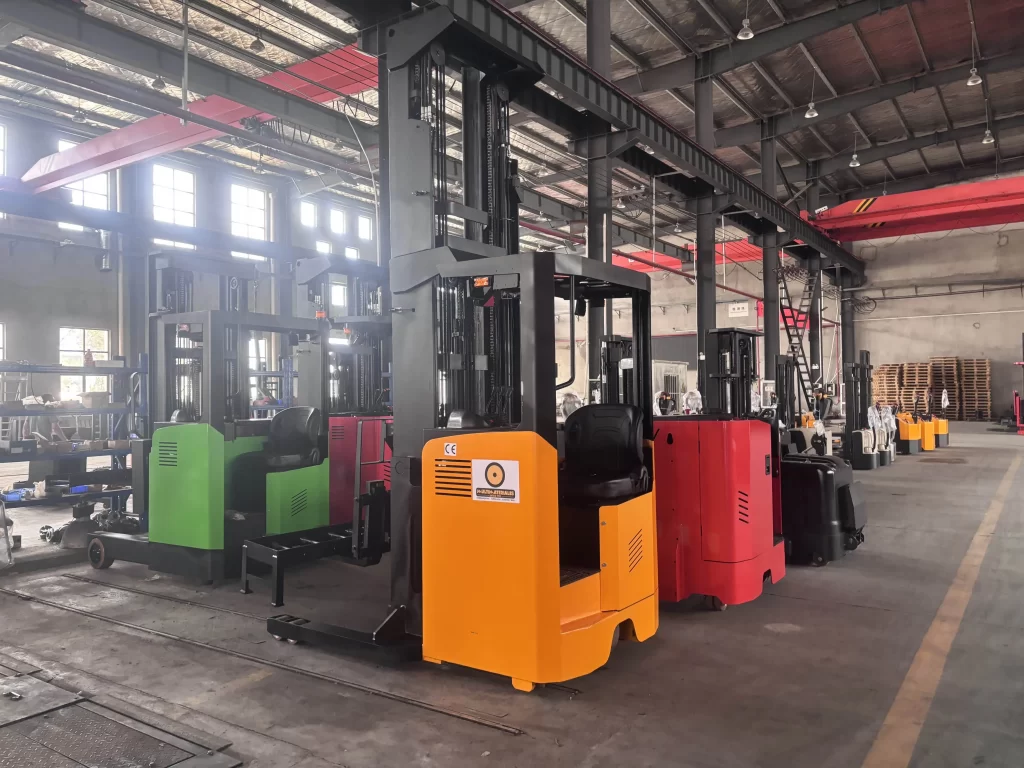
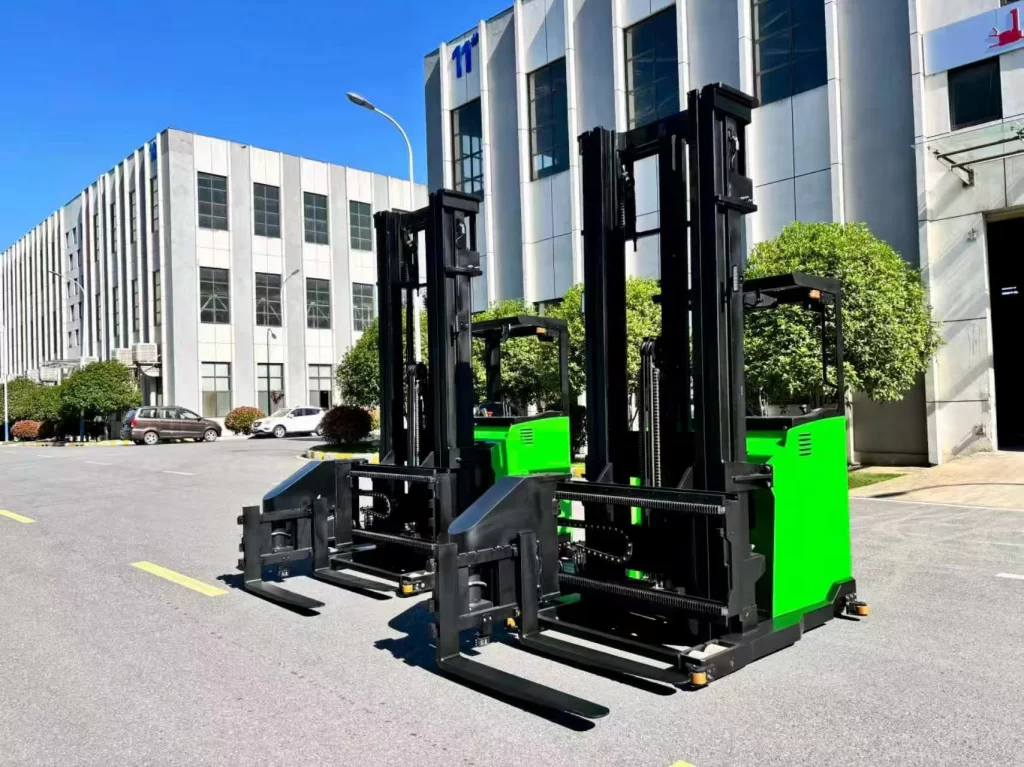
- Reach Truck: The mast and forks of this forklift can extend and retract to pick up loads, making it ideal for high, narrow aisles.
- VNA Truck: Used for very narrow aisles and high-density storage.
- This article focuses specifically on the comparison between three-wheel and four-wheel counterbalance forklifts.
What is a 3-Wheel Electric Forklift?
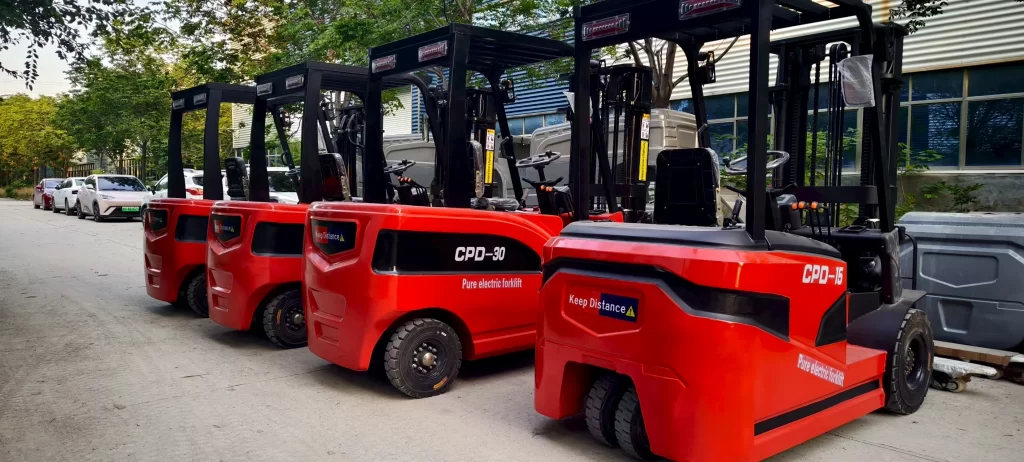
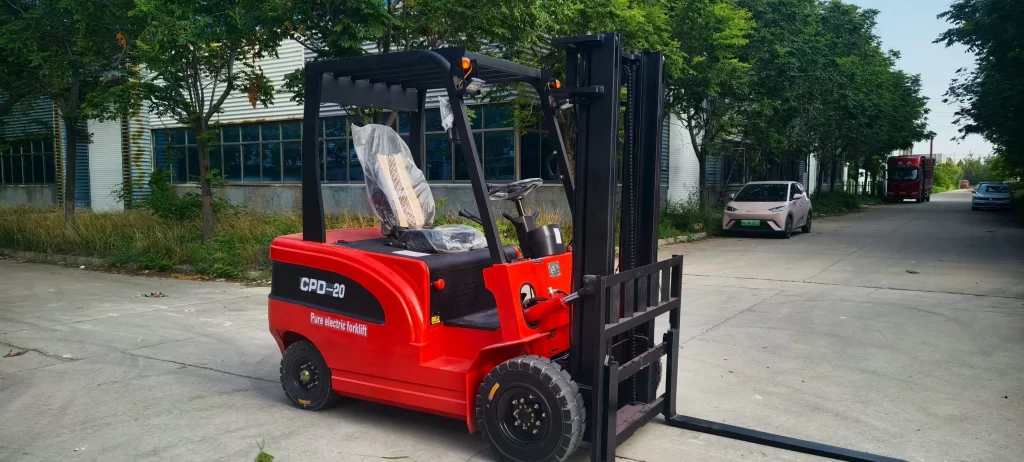
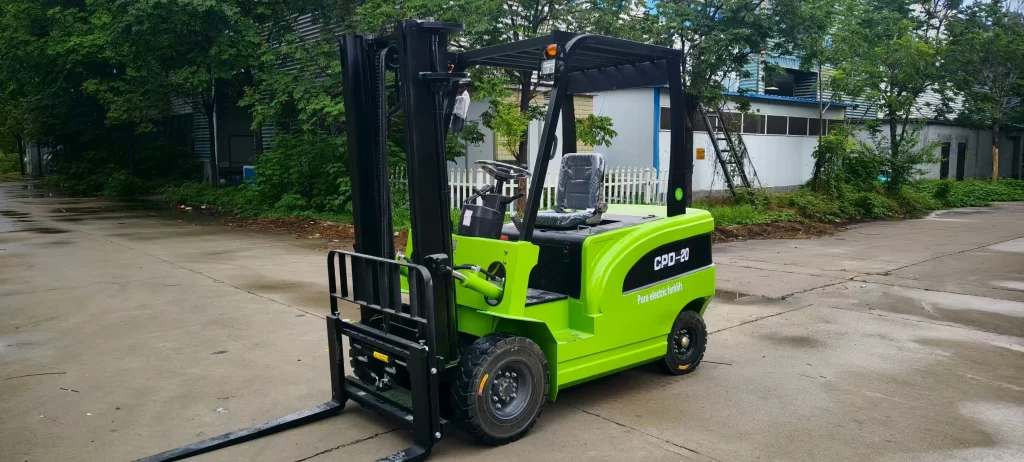
Please review the following advantages and main features of the three-wheel electric forklift.
Core Design and Mechanics
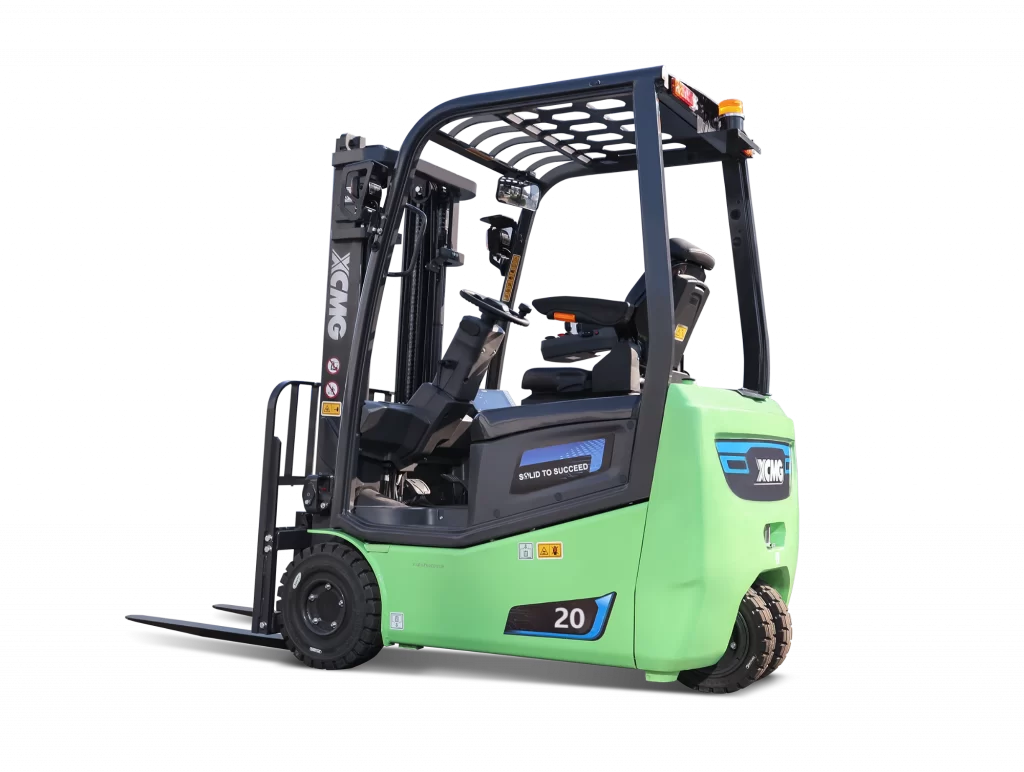
The three-wheel forklift has the following main characteristics:
- Three-Point Structure: This material handling tool primarily consists of two front load-bearing wheels and one rear drive/steering wheel.
- The drive wheel is also responsible for steering, allowing for an approach angle of nearly 90°.
- Extremely Small Turning Radius: Typically around 1.5 meters, with some models able to achieve as low as 1.3 meters.
Key Advantages at a Glance
The three-wheel electric forklift is an ideal machine for indoor operation. It offers significant advantages in environmental friendliness, ease of operation, economy, safety, and adaptability, making it an ideal choice for modern logistics and warehousing industries aiming to reduce costs, increase efficiency, and achieve green development.
- The extremely small turning radius grants this electric forklift high maneuverability, perfect for narrow aisle, two-way operation.
- The forklift has a compact body, is manufactured using high-strength steel, and has a small footprint.
- It is flexible to operate and easy for novices to learn quickly. The operation method is identical to that of a four-wheel counterbalance forklift.
- It is suitable for light to medium-duty indoor applications.
Where 3-Wheel Forklifts Shine
The three-wheel electric forklift is a narrow-aisle indoor forklift, suitable for working in confined spaces.
- Narrow aisle warehouses (<3 meters).
- Loading and unloading inside shipping containers.
- Light handling in retail, food, and pharmaceutical industries.
- Dense storage areas.
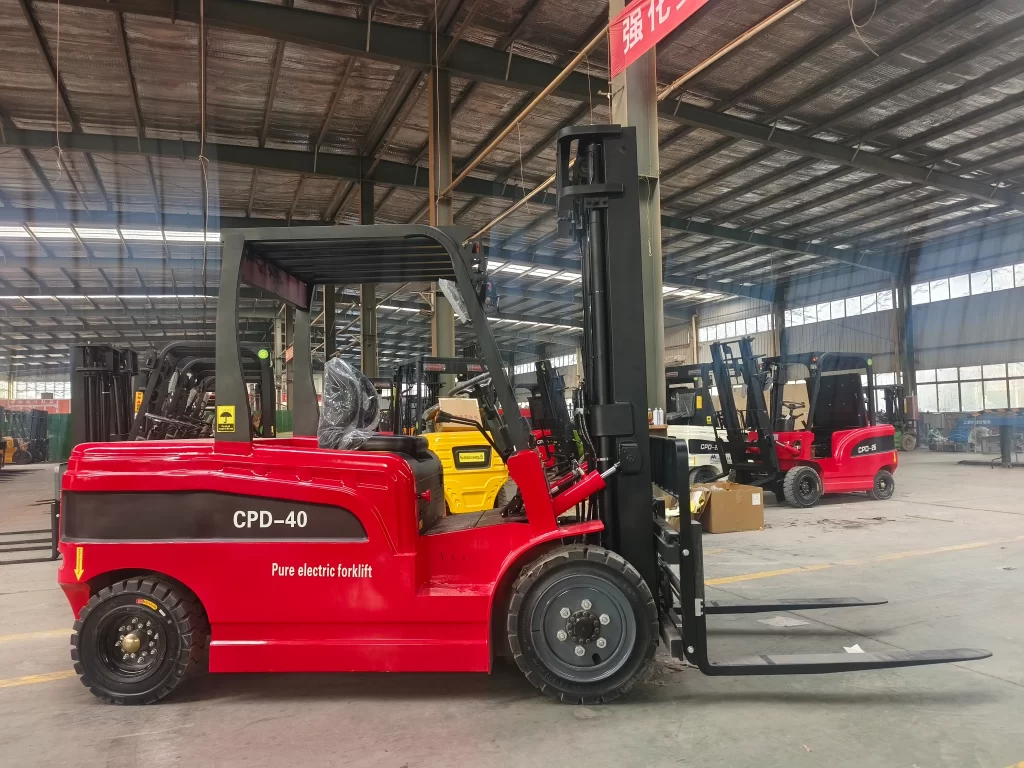
What is a 4-Wheel Electric Forklift?
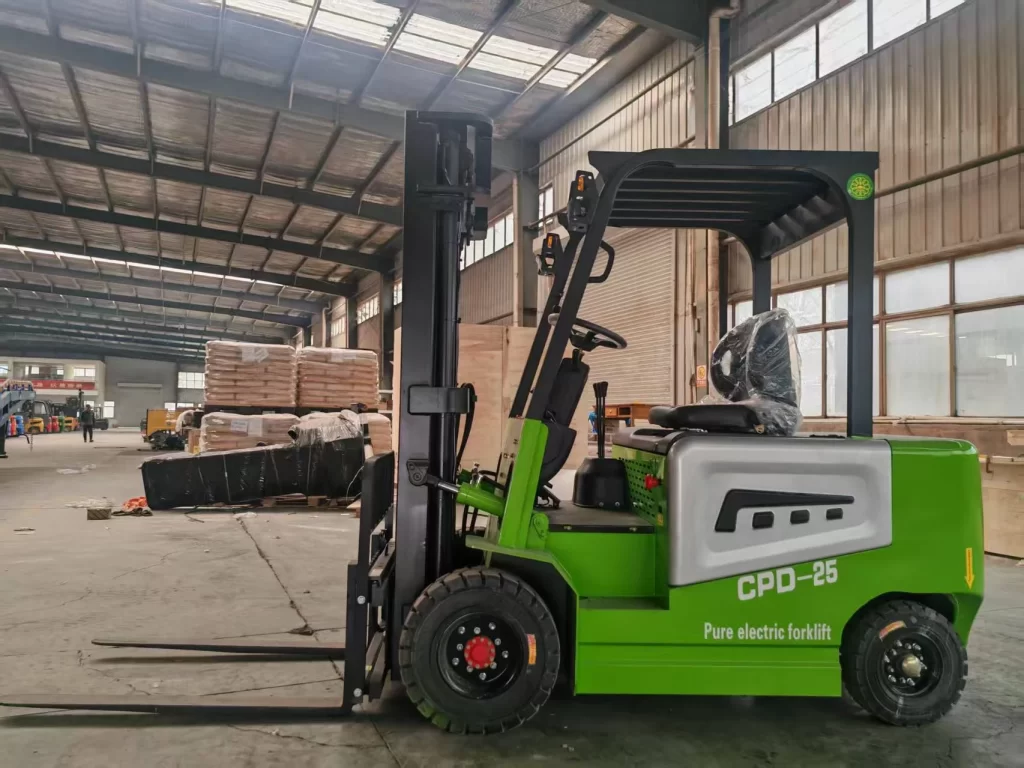
Core Design and Mechanics
- Four-Point Structure: Two front drive wheels and two rear steering wheels (or variations thereof).
- Stable support points on both the front and rear axles provide a more even weight distribution.
- Relatively Larger Turning Radius: Typically around 2.0 meters.
- Can be equipped with various forklift attachments, such as paper roll clamps.
Key Advantages at a Glance
The four-wheel electric forklift offers the following main advantages:
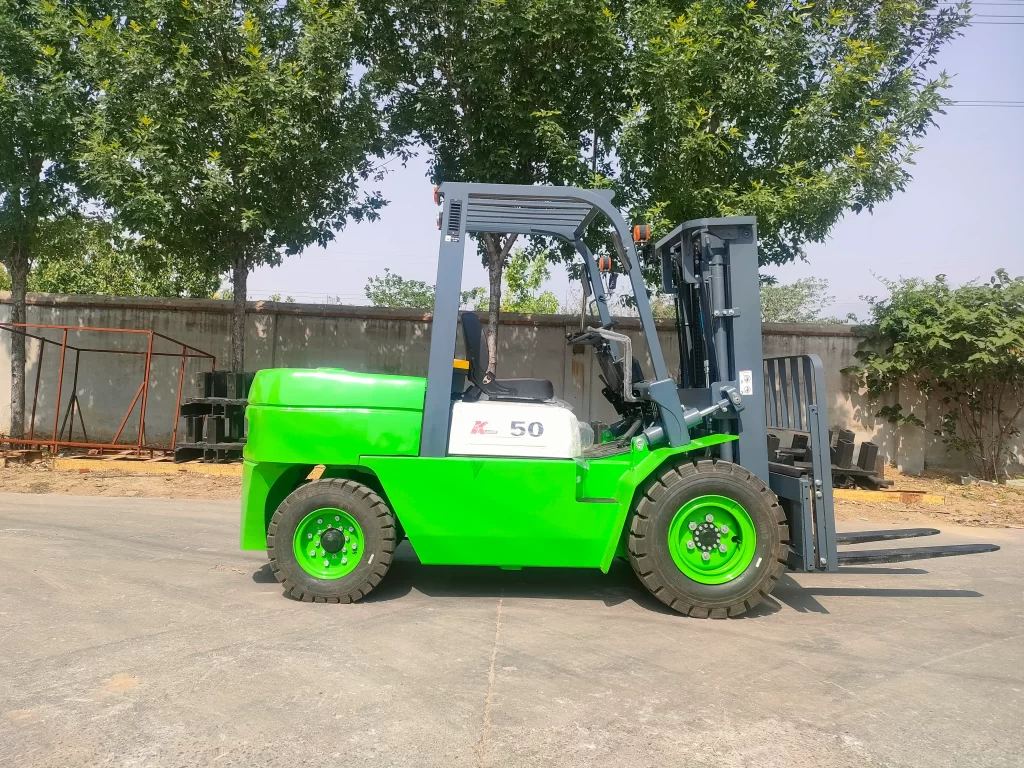
- Higher Residual Load Capacity and Overall Stability: With the development of motor technology, the load capacity of electric forklifts has greatly increased, ranging from 1T to 10T. The stability of a four-wheel counterbalance electric forklift is superior to a three-wheel model, hence its stronger load capacity.
- High Mast Stability: Sway is minimal during high-level lifting, offering greater safety. Lifting height can reach around 7 meters.
- A four-wheel electric forklift can support a larger battery capacity and longer working hours.
- Better Operator Comfort: This forklift uses ergonomic design and shock-absorbing seats. It is very stable, making it suitable for seated, long-shift operations.
Where 4-Wheel Forklifts Excel
The four-wheel counterbalance electric forklift is suitable for both indoor and outdoor use and can be fitted with either solid or pneumatic tires.
- Wide aisle warehouses (>3.5 meters).
- High-rack areas (lifting over 6-7 meters).
- Warehouses, cold chains, ports, mines, and other potentially flammable or explosive environments. Suitable for heavy loads or multi-shift operations (with battery rotation). Fast-charging lithium-ion forklifts can be adopted to increase charging speed.
- Outdoor operations on level ground (usually equipped with solid tires).
3-Wheel vs 4-Wheel Electric Forklift: Key Differences Head-to-Head
1. Aisle Width and Space Requirements
You need to calculate the width between your warehouse racks to choose the right truck.
- 3-Wheel: The minimum aisle requirement can be as low as 2.8-3.0 meters (including load turning space).
- 4-Wheel: Typically requires an aisle width of 3.5 meters or more for comfortable operation.
- If your warehouse rack spacing is limited, a three-wheel model will free up more storage positions.
2. Turning Radius and Maneuverability
Because the structure and design of electric forklifts are relatively simple, and the main component—the motor—is compact, electric forklifts can achieve a smaller overall size and turning radius.
- 3-Wheel: Single rear-wheel steering with a turning radius of only about 1.5 meters, requiring minimal space for a U-turn.
- 4-Wheel: Ackermann steering with a turning radius of about 2.0 meters, requiring more turning space.
- In extremely narrow spaces like cross-aisles or inside containers, the advantages of a three-wheel forklift are irreplaceable.
3. Stability and Load Handling at Height
- 3-Wheel: Three-point support; the center-of-gravity triangle is smaller during high lifting. Stability begins to noticeably decrease beyond 5-6 meters, increasing the risk of lateral sway.
- 4-Wheel: Four points create a rectangular stability plane, providing greater steadiness for high-rack operation.
- Recommendation: For high-rack warehouses, prioritize a four-wheel model; for low to medium-height handling, a three-wheel model is suitable.
4. Load Capacity Comparison
Lower load capacity is a disadvantage of the three-wheel electric forklift, caused by its structural design. If the load is too heavy, a three-wheel forklift can become unbalanced, leading to accidents. Conversely, the load capacity of a four-wheel counterbalance electric forklift can approach that of a diesel forklift, and the electric version offers the advantages of smooth power delivery and simple operation, making it suitable for novices.
- 3-Wheel: Typically in the 1.0-2.5 ton range.
- 4-Wheel: 1 to 10 tons, covering both medium and heavy loads.
- If your long-term load requirement regularly exceeds 2.5 tons, you should choose a four-wheel forklift directly.
5. Outdoor Usability and Floor Conditions
The usage environment for electric forklifts is primarily indoors, with some outdoor use possible. They can be equipped with non-marking tires to meet the demands of dust-free warehouses.
- 3-Wheel: Primarily designed for indoor, level ground. Outdoor use is limited (solid tires struggle with bumps).
- 4-Wheel: Some models can be equipped with suspension or larger tires to occasionally handle smooth, outdoor surfaces.
- If outdoor loading/unloading is involved, choose a four-wheel model and confirm the tire configuration.
6. Operator Comfort and Fatigue
- 3-Wheel: Compact design; the overhead guard area is slightly smaller. The comfort difference is not significant for short-term operation.
- 4-Wheel: The cabin is generally more spacious, with better suspension and damping, suitable for an 8-hour shift.
- For multi-shift warehouses, a four-wheel forklift can significantly reduce operator fatigue.
7. Acquisition and Operating Costs
- 3-Wheel: Lower initial purchase cost ($10k-$20k), lower electricity consumption, and low maintenance costs.
- 4-Wheel: Slightly higher initial price ($4k-$35k), but a better cost-per-move for heavy-load/long-duration operations.
- General Cost Advice: Make a TCO calculation based on your operation intensity, not just the standalone machine price.
Side-by-Side Comparison Table
| Comparison Dimension | 3-Wheel Electric Forklift | 4-Wheel Electric Forklift |
|---|---|---|
| Min. Turning Radius | 1.3-1.6m | 1.9-2.2m |
| Recommended Aisle Width | 2.8-3.2m | 3.3-3.8m |
| Load Capacity | 1.0-2.5 tons | 1-10 tons |
| High-Lift Stability (>6m) | Low | Excellent |
| Outdoor Usability | Limited (paved surfaces) | Moderate (tire options available) |
| Operator Comfort | Suitable for short/medium shifts | Suitable for long shifts/multi-shift |
| Initial Cost | Lower | Medium |
| Best Scenario | Narrow aisles, light/medium loads, dense storage | Wide aisles, heavy loads, high racks, outdoor |
How to Choose Based on Your Specific Warehouse Layout
Choose a 3-Wheel Electric Forklift if…
The main reason to choose a three-wheel electric forklift is to maximize warehouse space utilization to accommodate more goods, where the goods are relatively light and rack heights are low. Three-wheel electric forklifts come in both stand-up and seated operation models, allowing you to choose based on your preference.
- Your warehouse aisle width is between 2.8-3.2 meters, and space is precious.
- You need to work inside shipping containers or truck trailers.
- Your maximum lift height does not exceed 5-6 meters.
- Your loads are primarily under 2 tons, with a focus on fast handling. For goods exceeding 2.5T, you should strongly consider a four-wheel electric forklift or a reach truck.
Choose a 4-Wheel Electric Forklift if…
The electric four-wheel forklift is a mature type of electric forklift. Its load capacity is very strong, and it can be modified with a large-capacity forklift battery or additional attachments.
- Your aisles are spacious (>3.5 meters) with sufficient operating room. This forklift is ideal for distribution centers where warehouse space or the number of goods is less of a constraint.
- You need to handle heavy loads (>2.5 tons) frequently.
- Your operations involve high-rack areas (6 meters or higher).
- You run multi-shift operations, and operator comfort is a core metric.
- You occasionally need to work in an outdoor loading/unloading area.
Common Mistakes When Choosing Between 3-Wheel and 4-Wheel
Below are some common mistake scenarios when selecting an electric forklift. Avoid these errors in your selection process.
- Looking only at price and ignoring aisle width: Choosing a cheaper four-wheel counterbalance forklift that cannot turn properly within your rack spacing will reduce your work efficiency or cause accidents.
- Overestimating the stability of a three-wheel forklift: Using a low-to-medium level forklift for high racks creates a safety hazard. Exceeding the load capacity of a three-wheel forklift can cause a tip-over accident.
- Using an indoor forklift directly outdoors: A three-wheel forklift is highly prone to tilting or losing control on bumpy roads. A four-wheel electric forklift is suitable for relatively level outdoor ground; wet, muddy, or slippery ground will make it difficult for any electric forklift to move or handle loads.
Frequently Asked Questions
Is a 3-wheel forklift stable enough?
For low-to-medium level operations (<5-6 meters), a three-wheel forklift has sufficient stability. But if you frequently lift over 6 meters or handle extra-wide loads, a four-wheel forklift is safer. A reach truck is a type of high-level electric forklift suitable for narrow aisle and 10-meter rack warehouse operations.
Can a 4-wheel electric forklift work in narrow aisles?
It depends on the specific aisle width. Most four-wheel forklifts need aisles over 3.5 meters. If the aisle is under 3.2 meters, a three-wheel forklift is a better choice, or a reach truck and VNA truck are other excellent alternatives.
Which is better for a small warehouse?
Typically, a three-wheel electric forklift is more suitable because its compact design maximizes storage space and adapts to more flexible layouts. Reach trucks or VNA trucks are also suitable for narrow-aisle warehouse work. As a reach truck manufacturer, we can also provide you with cost-effective narrow-aisle forklifts.
Do 3-wheel forklifts cost less to maintain?
Electric forklifts are easy to maintain overall, and their long-term maintenance costs are much lower than diesel forklifts. Yes. The tires on a three-wheel forklift wear more evenly, the overall structure is simpler, and the maintenance cost is usually lower than that of a four-wheel forklift.
Conclusion: Match the Forklift to Your Layout, Not the Other Way Around
As a Chinese manufacturer specializing in forklifts and material handling solutions with over 10 years of production and import/export experience, here is our advice when you are choosing an electric forklift:
- There is no absolute “better” between a three-wheel and four-wheel electric forklift. The decision hinges on your aisle width, lift height, and load requirements.
- If warehouse space is tight and you pursue extremely high maneuverability and cost-effectiveness, a three-wheel forklift is the wise choice.
- If the warehouse is spacious and requires heavy loads, high racks, and comfortable, all-day operation, a four-wheel forklift is the more reliable long-term investment.
- If you need to balance warehouse space with a high lift height (12 meters) and a relatively heavy load (3T), and your budget is limited, a reach truck is a viable option.
- One-sentence takeaway: Measure your rack aisle and maximum lift requirements first, then let the forklift adapt to the warehouse—not the other way around.
📞 Not sure which configuration is the best fit for your warehouse? Contact us for a free warehouse layout assessment and a customized forklift solution.